
Aletheia-Probe
A New Weapon Against Predatory Journals

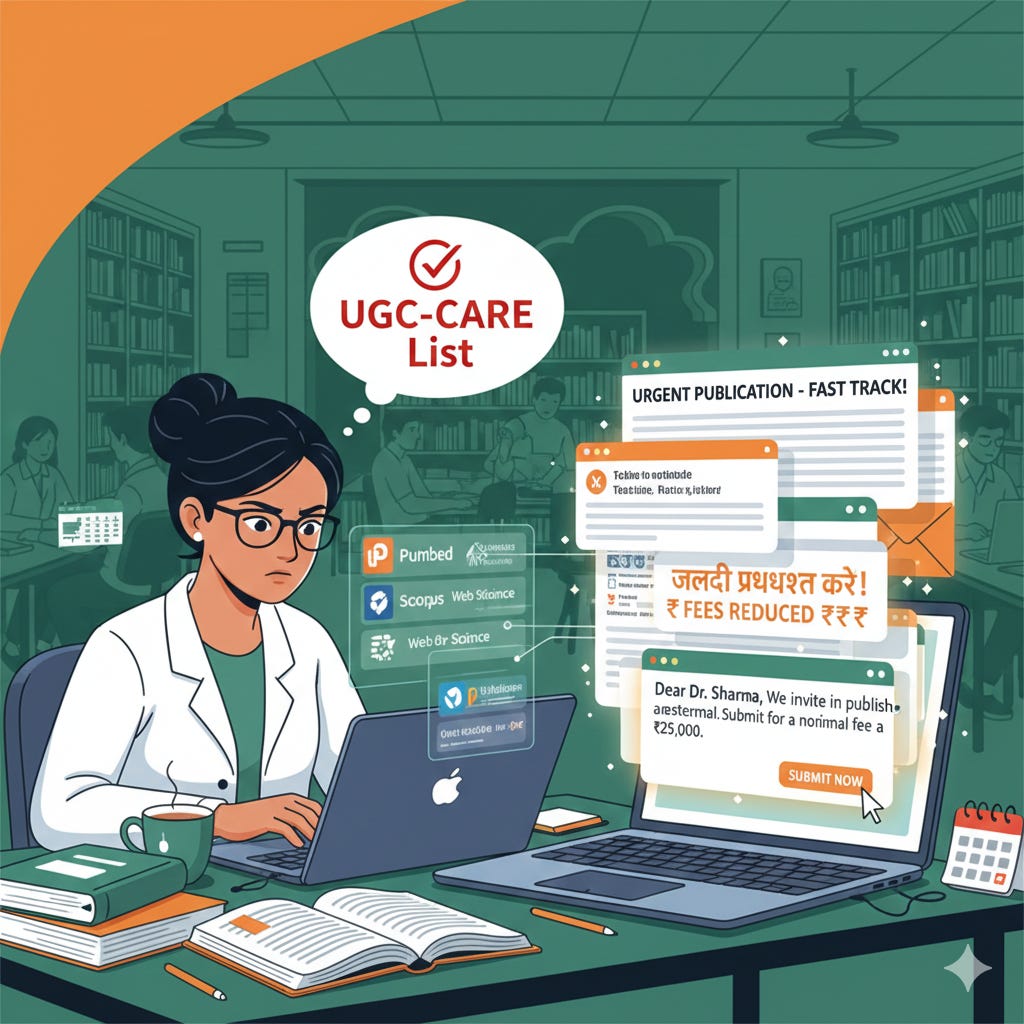
If you’re an Indian researcher, you know the drill. Your inbox is flooded with invitations: “Dear esteemed colleague, we invite you to submit to the International Journal of Advanced Sciences and Everything...” The email promises rapid publication, prestigious editorial boards, and global indexing. The reality? A predatory journal that will take your hard-earned money and give you nothing but a damaged reputation in return.
With over 18,000 predatory journals operating globally, and Indian researchers among the most targeted, a new open-source tool called Aletheia-Probe offers hope. But before you get too excited, there’s an important caveat: it requires command-line skills that many Indian researchers may not have.
The Indian Context: Why We’re Particularly Vulnerable
India has become a hotspot for predatory publishing. The reasons are clear:
Academic Pressure Cooker: With the Academic Performance Indicator (API) scores and University Grants Commission (UGC) emphasis on publication numbers for promotions and PhD submissions, Indian researchers face immense pressure to publish quickly and frequently.
Language Barriers: Many Indian researchers, especially those from regional universities, may struggle with English-language publication requirements, making them easy targets for journals that promise “easy acceptance.”
Limited Awareness: A 2022 global survey found that nearly 1 in 4 researchers worldwide has unknowingly published in predatory venues. In India, where many universities lack robust research training programs, this number could be even higher.
Financial Exploitation: Article Processing Charges (APCs) ranging from ₹20,000 to ₹2,00,000 represent significant sums for researchers, especially those at state universities or smaller colleges without substantial research grants.
The University Grants Commission (UGC) maintains a list of approved journals, but it’s not comprehensive. Many legitimate journals aren’t on it, and researchers working in niche areas often struggle to find suitable UGC-approved venues. This creates a dangerous middle ground where predatory publishers thrive.
What Is Aletheia-Probe?
Created by Andreas Florath, a software developer in Germany, Aletheia-Probe (named after the Greek word for “truth”) is essentially a virus scanner for academic journals. Instead of checking one database at a time—DOAJ, UGC-CARE, Scopus, Web of Science—it aggregates data from about a dozen authoritative sources and gives you a transparent assessment in seconds.
The tool checks journals against:
Directory of Open Access Journals (DOAJ)
Beall’s List of predatory publishers
Scopus and Web of Science indexing
CrossRef metadata
National ministry lists
Community-curated databases
What makes it different? Instead of a simple yes/no answer, it shows you the evidence:
Journal: “Current Science”
Result: LEGITIMATE (confidence: 0.95)
Reasoning: Indexed in Scopus, listed in UGC-CARE, registered with CrossRef
Or for a questionable journal:
Journal: “International Journal of Innovation in Science”
Result: PREDATORY (confidence: 0.85)
Reasoning: Publisher on Beall’s List, not in DOAJ or Scopus, suspicious domain
The Command-Line Barrier: A Major Limitation for Indian Researchers
Here’s the problem: Aletheia-Probe only works through the command line. There’s no graphical user interface, no website you can visit, no app you can download.
To use it, you need to:
Install Python on your computer
Open Terminal (Mac/Linux) or Command Prompt (Windows)
Use pip (Python package installer)
Run commands like:
aletheia-probe journal “Journal Name”
For researchers in IITs, IISc, IISER, or computer science departments, this might be straightforward. But for faculty in humanities, social sciences, or regional universities who primarily work with Word and Excel, this is a significant barrier.
The reality: Many Indian researchers—particularly those in non-technical fields or at institutions with limited IT infrastructure—may find this tool inaccessible despite its usefulness.
Practical Limitations for Indian Context
Beyond the technical barrier, there are other considerations:
Regional Journal Coverage: The tool may return “INSUFFICIENT_DATA” for many legitimate Indian regional journals, especially those published in Hindi, Tamil, Telugu, or other Indian languages. The databases it checks are heavily weighted toward English-language, Western journals.
UGC-CARE Integration: While the tool checks multiple databases, explicit integration with UGC-CARE list isn’t highlighted. Indian researchers still need to cross-check against UGC requirements separately.
Internet Dependency: The initial setup requires downloading substantial database files. This could be challenging with slow or unreliable internet connections common in smaller towns.
While Aletheia-Probe is a step forward, what the Indian research community really needs is:
A Simple Web Interface: Upload your bibliography, get results—no coding required
UGC-CARE Integration: Direct checking against India’s official approved list
Regional Language Support: Better coverage of legitimate Indian journals in regional languages
Mobile App: Check journals on the go from your smartphone
Institutional Support: University libraries should run these checks as a service
Looking Ahead: Hope for Easier Access
The good news? The tool is open-source, meaning the developer community could potentially build user-friendly interfaces on top of it. Indian tech-savvy researchers or university IT departments could create:
A simple web portal for their institution
Integration into library management systems
WhatsApp bot interfaces (given India’s WhatsApp adoption)
Mobile apps that make it as easy as scanning a QR code
Someone should build these. The tool exists; we just need to make it accessible.
Final Thoughts: Great Idea, Needs Better Execution for India
Aletheia-Probe is a valuable, transparent step against predatory publishing, automating checks better than manual methods. However, its command-line requirement limits its use in India’s less-elite academic environment, where many lack the technical skills. For those comfortable with Terminal and Python, it’s recommended. Otherwise, Indian researchers should stick to the UGC-CARE list and librarian/colleague consultation.
The predatory publishing problem won’t be solved by tools alone—it requires systemic change in how we evaluate research, pressure from funding agencies, and better training for early-career researchers. But every tool that makes verification easier is a step in the right direction.
Just make sure you can actually use it first.
You can download Aletheia-Probe here:
https://github.com/sustainet-guardian/aletheia-probe
Additional Resources
Florath, A. (2026). Aletheia-Probe: A Tool for Automated Journal Assessment. arXiv:2601.10431
International Committee of Medical Journal Editors. (2025). Predatory journals: what can we do to protect their prey? Journal of Korean Medical Science, 40(2).
Talley, N.J., et al. (2024). The rise and rise of predatory journals: the APAME 2024 Sydney declaration. Medical Journal of Australia, 221(5), 248-250.